Discover the latest petrol price trends in Chennai and Tamil Nadu for May 2026. Learn why fuel prices are surging, with Vizag crossing ₹116, and how it impacts your daily commute and logistics.
Petrol Prices on the Rise: Decoding the Fuel Surge in Chennai, Tamil Nadu, and Beyond
If you’ve pulled up to a fuel station recently, you’ve likely noticed the numbers on the meter climbing faster than usual. After a period of relative stability in early 2026, retail fuel prices are experiencing a sharp upward trajectory across India.
Recently, petrol prices in the coastal city of Visakhapatnam (Vizag) breached the historic ₹116-mark, triggering widespread concern among motorists and the logistics sector. But what does this steep mid-May revision mean for residents down south in Chennai and the rest of Tamil Nadu?
Here is a comprehensive breakdown of the current petrol price trends, the global factors driving the surge, and how it impacts your wallet.
The Vizag Warning Bell: Crossing the ₹116 Mark
To understand the broader trend, we first need to look at the sudden spike in Andhra Pradesh. For the first four months of the fiscal year, fuel prices in Vizag remained relatively stagnant. However, a rapid succession of retail price corrections mid-May pushed petrol to a staggering ₹116.38 per litre, while High-Speed Diesel (HSD) escalated to ₹104.11 per litre.
This cumulative hike of over ₹5.50 per litre in just over a week has sent shockwaves through local independent transport bodies, who are warning that secondary inflationary pressure on essential commodities is now inevitable.
Current Petrol Prices in Chennai and Tamil Nadu (May 2026)
While Tamil Nadu hasn’t quite hit the historic highs seen in Vizag, the upward trend is unmistakable and closely mirrors the national fuel inflation wave.
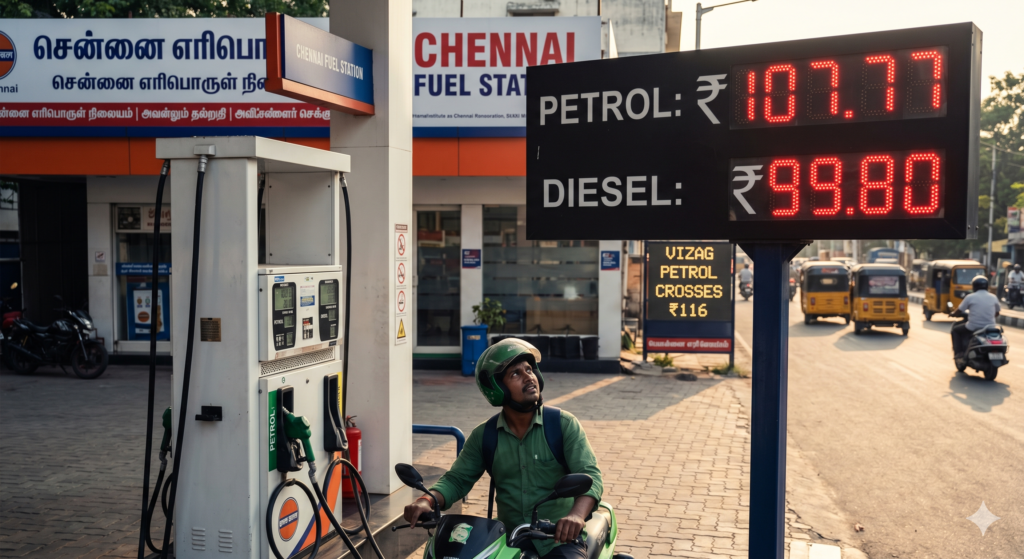
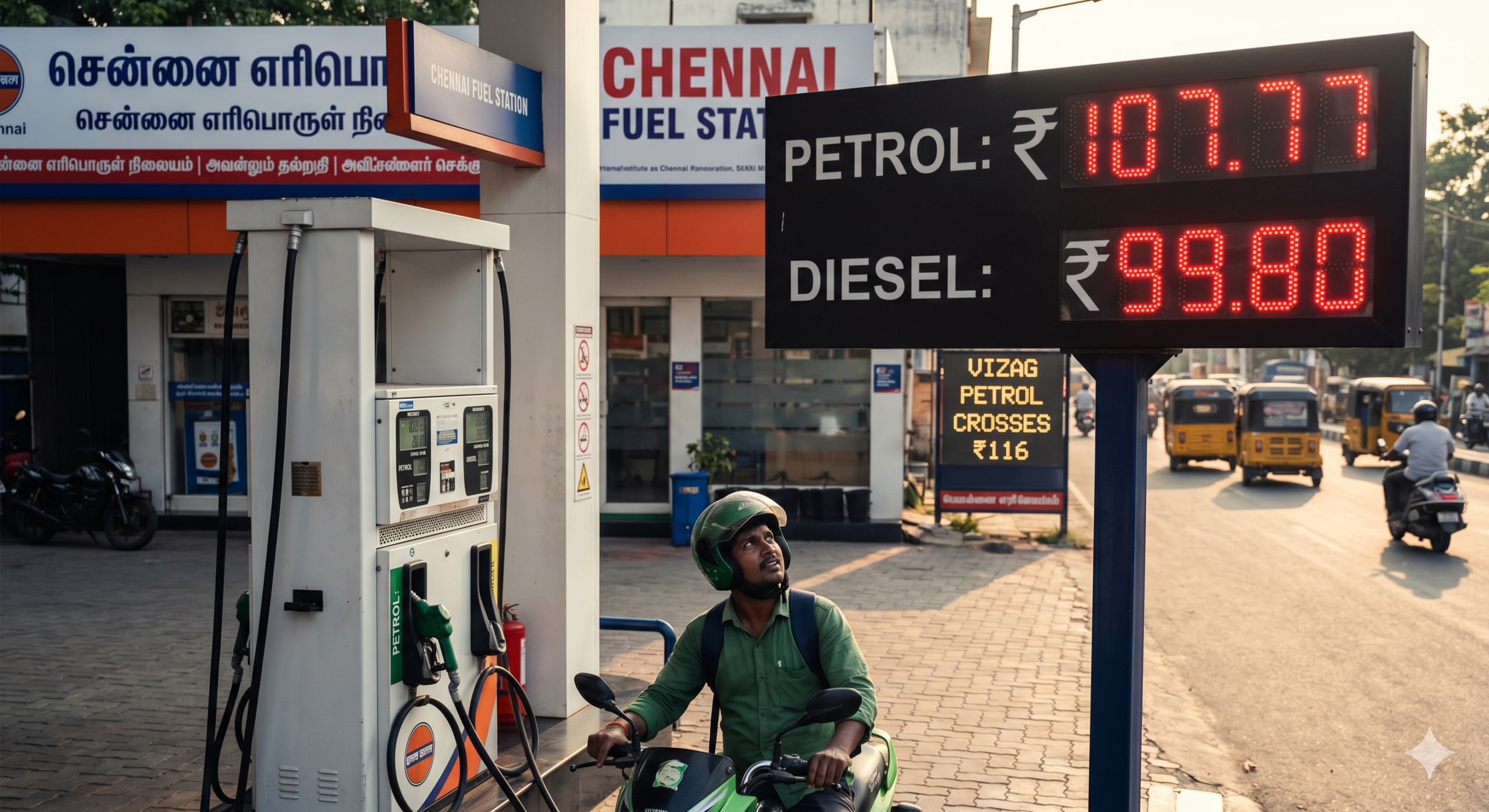
- Chennai City Limits: As of late May 2026, the petrol price in Chennai is hovering around ₹107.77 per litre. Just weeks ago, at the start of the month, prices were sitting comfortably around the ₹101.06 mark. This represents a substantial hike of over ₹6.70 within a single month.
- Across Tamil Nadu: The state-wide average for petrol is currently tracing near ₹108.83 per litre, with certain districts experiencing even higher rates due to localized transportation costs. For instance, in hilly and remote regions like the Nilgiris, petrol has surged closer to ₹109.84 per litre.
Much like Vizag, the stability observed in Chennai between January and April has collapsed, leaving daily commuters adjusting their monthly budgets.
Why Are Fuel Prices Surging Right Now?
The sudden jump at the pumps isn’t happening in a vacuum. Several macroeconomic factors are converging to push prices higher:
- International Crude Oil Costs: The landing cost of crude oil in the global market has seen a sharp increase. Since India imports a massive majority of its crude oil requirements, any international price hike directly impacts domestic Oil Marketing Companies (OMCs).
- West Asia Supply Disruptions: Compounding geopolitical tensions and supply chain disruptions in the Middle East have created a volatile global oil market, forcing OMCs to execute sharp hikes to cushion their mounting under-recoveries.
- Currency Fluctuations: The Rupee-Dollar exchange rate plays a crucial role. A depreciating rupee makes crude oil imports substantially more expensive.
- State VAT and Duties: While base prices are rising globally, the final retail price is also heavily influenced by state-level Value Added Tax (VAT) and central excise duties, which explains the price disparities between cities like Vizag and Chennai.
The Ripple Effect: Freight, Logistics, and Inflation
The most immediate concern with rising fuel costs—particularly diesel—is the “domino effect” it has on the broader economy.
In industrial corridors, logistics providers rely heavily on stable fuel prices to maintain their operational mathematics. When diesel prices escalate, independent transport networks are forced to upwardly revise their freight tariffs. For the average consumer in Chennai and Tamil Nadu, this means the cost of transporting essential commodities, fresh produce, and industrial cargo goes up. Ultimately, this secondary inflation is passed down to the retail consumer, affecting grocery bills and everyday expenses.
What’s Next for Fuel Consumers?
Predicting the exact peak of this pricing wave is challenging, as it relies heavily on international geopolitical stability and global crude production rates. For now, motorists in Chennai and Tamil Nadu should brace for continued volatility.
Pro-Tips for Commuters:
- Opt for Carpooling: Sharing rides to work can significantly cut down individual fuel expenditures.
- Maintain Your Vehicle: Regular servicing, proper tire pressure, and smooth driving habits can dramatically improve your vehicle’s fuel efficiency.
- Monitor Daily Prices: Since fuel prices are revised daily at 6:00 AM, keeping an eye on the rates can help you time your refuelling slightly better.
The era of cheap fuel seems to be on pause. As global markets attempt to stabilize, local consumers and industries alike will need to adapt to the new, elevated baseline of transportation costs.